


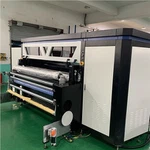


Best Way To Print On Fabric
Preprocessing
1. Block the fiber capillary, significantly reduce the capillary effect of the fiber, prevent the dye from printing on the surface of the fabric, and obtain a clear pattern.
2. The additives in the slurry can promote the combination of the dye and the fiber in the hot and humid state to obtain a certain color depth and color fastness.
3. After sizing, it can effectively solve the problems of fabric curling and wrinkling, improve the quality of the printed fabric, and prevent the nozzle from being damaged by the raised part of the fabric due to uneven fabric. 4. After sizing, the fabric becomes stiff, making it easier for the printer to feed the fabric.
Prepare slurry
The composition of slurry: paste, alkaline agent (baking soda), sodium sulfate, urea, sodium hexametaphosphate. Preparation method: add each component chemical and paste into deionized water in a certain proportion, and then stir rapidly with a mixer until no particles exist in the slurry. The order of adding the components:
Sodium hexametaphosphate - Yuanming powder - urea - paste - baking soda
The role of various components in the slurry
Sodium hexametaphosphate: chelate metal ions in water, such as calcium ions, magnesium ions, etc., to soften water quality
Urea: Hygroscopic and solubilizing, it can promote fiber expansion during steaming, and help dyes to fully dissolve, which is conducive to the penetration and reaction of dyes into the fiber. Sodium sulfate: When dyeing cellulose fiber (cotton, linen, etc.) fabrics, sodium sulfate (sodium sulfate) is usually used as a dyeing accelerator. Sodium sulfate can reduce the solubility of dyes in the bath and improve the utilization rate of dyes. Alkaline agent (baking soda): When steaming, the degree of ionization of the cellulose fiber is promoted to increase, so that the fiber and the reactive dye are valence bonded. Paste: The main function is to inhibit the dye from permeating on the fabric. The type of paste and the molecular structure have different inhibitory effects on the dye, which will affect the color yield, printing penetration and clarity after printing. The appropriate paste should be selected according to the fabric and the type of dye.
Fabric Sizing
The sizing of the fabric is divided into single-side sizing and double-side sizing. The one-side sizing is passed through the rotary screen or flat screen printing machine or layering machine, and the size is evenly covered on the surface of the fabric through the pressure of the magnetic rod or scraper through the screen. Double-sided sizing is also padding sizing (residual rate of 80%-90%), which is to squeeze the slurry onto the fabric through a rolling car, and can also be used in the double-sided sizing process of digital printing by modifying the stenter setting machine. .
Problems that should be paid attention to in sizing
1. Pay attention to the problem of the weft of the fabric during sizing. Once the weft of the fabric is skewed, the fabric will not be laid flat on the guide belt in the subsequent printing process, resulting in unevenness, which is easy to rub the nozzle, affecting the quality of the pattern and the service life of the nozzle. .
2. The fabric after sizing should be sealed and stored in time to prevent the proportion of the slurry components from changing and deteriorating due to the absorption of moisture and other substances in the air, which will cause problems such as bleeding of the pattern or insufficient color depth during printing.
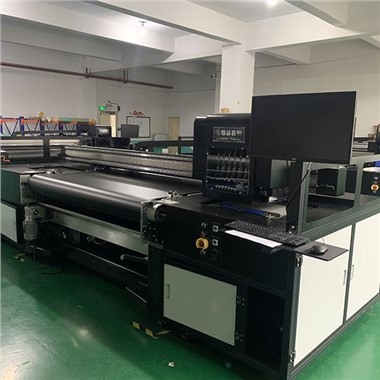
|
Product mode |
YSR1816 |
||
|
Print head |
8pcs Ricoh Gen6 print head |
||
|
Fabric conveyance mode |
Adhesive belt with cleaning and heating system |
||
|
Maximum medium width |
1850mm |
||
|
Production speed |
Gen5 E |
2 pass:330m2/h |
|
|
Print software |
Neostampa / Texprint |
||
|
Ink Type |
reactive , disperse or acid ink,pigment(8 color) |
||
|
Power voltage |
380V,3L+N+G(with independent reliable effective earth wire) |
||
|
Power consumption |
printer 15kw, electric dyer 20kw(steam dryer 4kw) |
||
|
Workshop condition |
Temperature:20-30℃,humidity:55-65% |
||
|
Measurement(with wooden case) |
Printer |
4700*2200*1950mm (L* W* H) |
|
|
Dryer |
2300*2200*1950mm (L* W* H) |
||
|
Weight |
G.W:4800kg N.W.:4200KG |
||


Previous
No InformationYou Might Also Like



Send Inquiry