

Classification by printing method
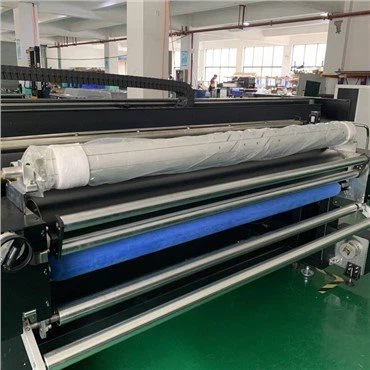
1. Digital direct printing: Digital direct printing is suitable for disperse, acid dyes, coatings, and active inks. Digital direct printing is a process of direct printing on semi-finished textiles that have been sizing. The process is: select the corresponding ink according to the textile, design the pattern, sizing, and then go to the textile direct printing machine for direct printing, and then dry, steam, wash, dry, soften and set (the coating can be fixed by baking)
2. Thermal transfer method: Thermal transfer printing is to first print the textile dye on paper (coating), and then use a thermal transfer printing machine to transfer the pattern on the paper to the textile. The advantage is that the precision is relatively high, but the printing efficiency is low. It can only be used for textiles with full polyester or high polyester content. The transfer fabrics are all processed by semi-finished products and no softener has been added (softeners may affect the coloring rate).
3. Cold transfer method: Like heat transfer, it is necessary to print the textile dye on paper first, and then use a special machine to emboss the paper and fabric to achieve the transfer of the pattern. There are two ways to process the fabric after embossing
One is to carry out traditional processing such as steaming, washing, and shaping;
The second is to carry out cold pile chemical reaction treatment to fix the color (the fabric needs to be chemically treated in advance).
Use active, disperse, acid and other dye inks, except for blended fabrics.
Classification by dye and process
1. Disperse digital printing: At present, more than 50% of the ink used for printing in my country is disperse dye ink, which is used for printing chemical fiber fabrics such as polyester fiber; disperse dyes are a type of non-ionic dyes with very low water solubility, which exist in a highly dispersed state in water with the help of dispersants when dyeing.
2. Reactive digital printing: Reactive dye ink accounts for about 29%, mainly used for silk and cotton fabric printing; reactive dyes, also known as reactive dyes. It is a type of dye that reacts chemically with fibers during dyeing. This type of dye contains genes that can react chemically with fibers. When dyeing, the dye reacts with the fiber, forming a covalent bond between the two and becoming a whole, which improves the washing and rubbing fastness. The active dye molecule includes two main components: the parent dye and the active group. The group that can react with the fiber is called the active group. At present, it is mainly used on woven and knitted fabrics such as cotton, linen, and silk, or fabrics with a high content of the above ingredients.
3. Acid digital printing: Acid dye ink has a small specific gravity, accounting for about 7%, and is used for printing fabrics such as wool and nylon. Acid dyes are a type of water-soluble dyes with acidic groups in their structure, which are dyed in an acidic medium. Most acid dyes contain sodium sulfonate, which can be dissolved in water, have bright colors, and a complete color spectrum. It is mainly used for dyeing wool, silk, nylon, etc., and can also be used in leather, paper, ink, etc. It generally has no coloring power on cellulose fibers.
4. Digital printing with pigment ink: The use of pigment ink in my country is relatively small, less than 2%, and most of them are foreign products. Manufacturers include Huntsman, BASF, DuPont, Klein and other companies.
Classification by fabric composition:
1. Digital printing mainly based on cotton, but linen, silk, etc. can also use reactive dye inks;
2. Digital printing mainly based on chemical fiber, produced with dispersed thermal sublimation dye ink and chemical fiber dispersed direct injection digital;
3. Fabrics such as T/C that cannot be operated with reactive, disperse, and acid dye inks are printed with coating inks;
4. Digital printing mainly based on nylon and wool, etc., is produced with acid dye inks, and silk can also be used.


